Monday, 29 December 2014

Yearwise collection

25 Paise Stainless Steel Collection
(Single Horned Rhino)


Years Issued: 1988-2002
Metal composition: Ferritic Stainless Steel (82 % Iron, 18% Chromium)
Mints: 1988-2002: Mumbai, Kolkata, Hyderabad, Noida
           1988: Canada (c)

===XXX===

50 Paise Stainless Steel Collection


Years Issued: 1988-2003 & 2007 : National Integration
                       2008-2010: Nritya Mudra
                       2011, 2013: New Rupee Symbol

I am still missing 2010 and 2013 coin in collection.

===XXX===

1 Rupee Stainless Steel Collection


Years Issued: 1992 - 2004 : Crop Series
                       2004-2006: Unity in Diversity
                       2007 - 2011: Nritya Mudra
                       2011 - Till Date: New Rupee symbol

In the year 2011, New series with a new Rupee symbol was introduced. Hence in 2011, coins of both nritya mudra and rupee symbol are found. I have both these in my collection as shown in above picture.

1 Rupee coins from 'unity in diversity' theme from the year 2004-2006 are rare to find in circulation. Coins of 2005 can be found somewhere but not others.

===XXX===

2 Rupees Collection

Years Issued: 1992- 2004 : National Integration
                       2005-2007: Unity in Diversity
                       2007-2011: Nritya Mudra
                       2011 - Till Date: New Rupee Symbol

I still have 2004 National Integration coin missing in my collection.

In the year 2007, new series of 'Natya Mudra' was introduced. Hence we can find coins of both 'Unity in Diversity' (X) and 'Natya Mudra' of year 2007. I have both coins in my collection.

===XXX===

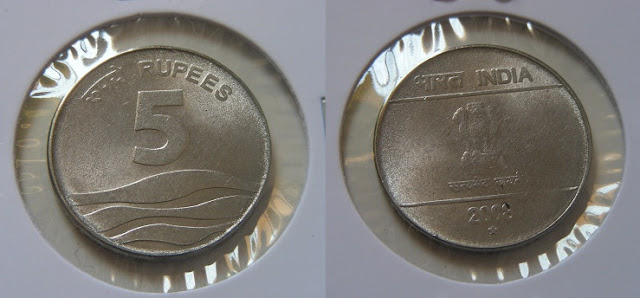
5 Rupees Collection

Years Issued: 1992-2004: Cu-Ni series
                       2007: Unity in Diversity (X)
                       2007-2008: Information Technology
                       2009 - 2010: Old 5 Rs. design with Nickel-Brass metal
                       2011 - Till date: New Rupee Symbol

2007 Unity in Diversity coin of 5Rs. is very rare and is very expensive in the market.
We find die varieties in both old Cu-Ni coins and its nickel-Brass versions.
Please refer the Post ' India - Die Varieties' for the details.

I still do not have 2007 Unity in Diversity coin in my collection.

===XXX===


Tuesday, 31 December 2013

India - Chatrapati Shivaji Maharaja

Maratha Emperor - Chatrapati Shivaji Maharaja

Chattrapati Shivaji [1630-1680], the great emperor , the founder of Hindu empire 'Hindavi Swarajya', who I admire the most, who is a pride of state of Maharashtra. Why Maharashtra? because today's Western Maharashtra was the major territory of his empire when he founded it. The empire is commonly know as 'Maratha Kingdom'. He was the great warrior and the only one who recreated and established Hindu empire at the time when the entire Hindustan was under the rules of 4 major Muslim dynasties Mughal, Adil Shahi, Qutb Shahi and Nizam Shai. Under these rules, the life of Hindu common man was nothing less then hell, when this great man rose by saying 'Hey Rajya Vave Ye To Shrinchi Iccha' means 'Its a God's wish this empire to be created (for Hindu common man)'! and took out the people from the shadow of Muslim rules to build 'Hindvai Swarajya' (Self-rule of Hindu people).

As far as coinage of his era is concerned, coins of gold, silver and copper are found. All coins bear the same wordings on both sides as below:

Obverse: Shri Raja Shiva
Reverse: Chatra Pati

The gold coin is known as 'Hon'. These 'Hon' coins are said to be very rare as it is believed that major number of gold coins were melted by Aurangzeb and British force when they overpowered the Maratha empire. Hence today, the price of 'Hon' is said to be in lakhs of rupees in India. Below is a snap of 'Hon' which I got to capture in one exhibitions held in Pune in 2011.


The silver coins is known as 'Raupya Mudra'[ means 'Silver coin']. This is also very rare in existence. Below is the snap of Raupya Mudra I saw in another exhibitions held in Pune in 2013.


I do not have both Gold and Silver coins of Shivaji Maharaja in my collection due to their high price.

However, I do have copper coins know as 'Shivrai' in my collection and as a numismatist I feel proud to have those in my collection.


Shivrai - After Corronation of Maharaja Chatrapati Shivaji Bhosale
The shivrai shown above is of the period after the corronation of Shivaji Maharaja as 'Chatrapati' [ after 1674]. This coin bears slight different design of doted circle inside which 'Shri Raja Shiva' and 'Chatrapati' is stamped on both sides of the coin.

Shivrai - said to be of Peshwa regime
The Shivrai shown above is a copper coin of Chatrapati Shivaji Maharaja. This is said to be of the period of Peshwas who were acting as a prime minister to Chatrapati Shahu Maharaj during the 18th century. There are lot of patterns observed in Shivrai coins in the form of symbols on it. In the above coin we can see a cresent [Chandra Core] after the letter 'Sri'.

These copper Shivrai coins were very popular in the British Bombay Presidency region [i.e. present day Maharashtra and Gujarat] and were in circulation even in 19th and early 20th century.

We dont find many patterns of coinage from Shiva Chatrapati period. This is because it was a time when Shivaji Maharaja built his empire from scratch by fighting with 3 major muslim dynasties. Hence he was completely busy in expanding and protecting his empire. Even he passed away at the age of just 50 years. Hence he didn't get time to think on coinage. After Shivaji Maharaj, Maratha kings 'Sambhaji Raje' and ' Rajaram Raje' kept Maratha fight alive for 27 years with Mughal emperor 'Aurangzeb'. Naturally the coinage of this period don't have much patterns and designs unlike Maharajas in Northern India who accepted alliance with Aurangzeb.

Click here to know more about Chatrapati Shivaji Maharaja.

Sunday, 3 March 2013

Germany: Deutsche Mark


For me, Germany is the most fascinating country in the world after Japan. I have been very curious about the era of Adolf Hitler, its partition after World War II and its reunification in 1990, its domination in the technology and associated businesses. I always loved German football team for their game skills. Having been read/heard so much about the partition of Hindustan, I feel that the reunification of East and West Germany was an outstanding event in human history. Hence I always wanted to have a German coin in my collection and Bingo..What a coin I have now.

Germany was using Deutsche Mark between 1948-2001. After the formation of European Union  currency 'Euro', Germany adopted 'Euro' as their main currency.

100 pfennig = 1 Deutsche Mark (1948-2001)

2 Deutsche Marks 
Years: 1990-2001
Metal: Copper-nickel plated Nickel
Weight: 7 gm
Diameter: 26.75 mm
Thickness: 1.79 mm
Demonetized: 12-31-2001

Commemorative issue: 40 years of Federal Republic of Germany.

Obverse: An eagle, emblem of Germany.
Reverse: Portrait of Franz Josef Strauß (1915-1988).

Franz Josef Strauss
He  was a highly influential political man. He notably was defense minister in 1956, in charge of rebuilding the Bundeswehr, chairman of the Bavarian political party CSU from 1961 on and Bavarian minister-president from 1978 to his death.
1949-1989 celebrate 40 years of the western Federal Republic, from its founding to its reunification in 1990. F.J. Strauss was a political actor during this period from the early 50s to his death in 1988.

Click here to know more about Franz Josef Strauss.
Click here to know more about Germany.

===XXX===


Iceland: Krona

Iceland is a Nordic European island country situated at the confluence of the North Atlantic and Arctic Oceans, on the Mid-Atlantic Ridge. Iceland is the most sparsely populated country in Europe. The capital and largest city is Reykjavík, with the surrounding areas in the southwestern region of the country being home to two-thirds of the country's population. The nation's capital is the most northern capital in the world. Iceland is volcanically and geologically active. The interior consists mainly of a plateau characterized by sand and lava fields, mountains and glaciers, while many glacial rivers flow to the sea through the lowlands.

100 Aurar = 1 króna


The landvættir (“land wights”) decorate the obverse (front) of the Icelandic króna coins, but animals of the ocean (fish, crabs and dolphins) appear on the reverse (back).


1 Krona
Years: 1989-2011
Metal: Nickel-plated Steel
Weight: 4 gm
Diameter: 21.5 mm
Thickness: 1.7 mm


Obverse: Denomination in words, "Landvættir" in circle.  Landvættir ("land wights") are spirits of the land in Norse mythology and in Germanic neopaganism. They protect and promote the flourishing of the specific places where they live, which can be as small as a rock or a corner of a field, or as large as a section of a country.

Reverse: Codfish along with the denomination value.


Atlantic Cod fish
Cod is popular as a food with a mild flavour and a dense, flaky white flesh. Cod livers are processed to make cod liver oil, an important source of vitamin A, vitamin D, vitamin E and omega-3 fatty acids (EPA and DHA). Young Atlantic cod or haddock prepared in strips for cooking is called scrod. In the United Kingdom, Atlantic cod is one of the most common ingredients in fish and chips, along with haddock and plaice. It is also frequently consumed in Portugal, Spain, Italy, France and Brazil. Cod flesh is moist and flaky when cooked and is white in colour.

Click here to know more about Cod.
Click here to know more about Iceland.

===XXX===

10 Kronur 
Years: 1996-2008
Metal: Nickel-plated Steel
Weight: 7 gm
Diameter: 27.5 mm
Thickness: 1.78 mm

Obverse: Central circle divided into four parts.The four parts (Dragon = East, Bird = North, Bull = West, Rock Giant = South) depict the symbols of guardian spirits used in the Seal of Iceland.

Reverse: Four Capelin fishes swimming left and the denomination value above.

Caplin Fish

The capelin or caplin, Mallotus villosus, is a small forage fish of the smelt family found in the Atlantic and Arctic oceans. In summer, it grazes on dense swarms of plankton at the edge of the ice shelf. Larger capelin also eat a great deal of krill and other crustaceans. Whales, seals, cod, squid, mackerel, beluga whales and seabirds all prey on capelin, in particular during the spawning season of the capelin while it migrates southwards. Capelin spawn on sandy beaches and sandy bottom at the age of 2–6 years, and have an extremely high mortality rate on the beaches after spawning, for males close to 100% mortality.[clarification needed] Males reach 20 cm in length, while females are up to 25 cm long. They are olive-colored dorsally, shading to silver on sides. Males have a translucent ridge on both sides of their bodies. The ventral aspects of the males iridesce reddish at the time of spawn.

Click here to know more about Caplin fishes.

Coat of Arms of Iceland
The supporters are the four protectors of Iceland (landvættir) standing on a pahoehoe lava block. The bull (Griðungur) is the protector of southwestern Iceland, the eagle or griffin (Gammur) protects northwestern Iceland, the dragon (Dreki) the northeastern part and the Rock-giant (Bergrisi) is the protector of southeastern Iceland. Great respect was given to these creatures of Iceland, so much that there was a law during the time of the Vikings that no ship should bear grimacing symbols (most often dragonheads on the bow of the ship) when approaching Iceland. This was so the protectors would not be provoked unnecessarily.

Click here to know story about these guardian symbols.

===XXX===

100 Kronur 

Years: 1995-2011
Metal: Nickel-brass
Weight: 8.5 gm
Diameter: 25.5 mm
Thickness: 2.25 mm

Obverse: Central circle divided into four parts. The four parts (Dragon = East, Bird = North, Bull = West, Rock Giant = South) depict the "Landvættir" guardian spirits used in the Seal of Iceland.

Reverse: Lumpsucker fish swimming to left and the denomonation value below.

Toad and Pacific Spiny Lumpsuckers Demonstrating Adhesive Pelvic Discs
Lumpsuckers or lumpfish are marine fish of the family Cyclopteridae.The family name Cyclopteridae derives from the Greek words κύκλος (kyklos), meaning "circle", and πτέρυξ (pteryx), meaning "wing" or "fin", in reference to the circle-shaped pectoral fins of this fish.
They are found in the cold waters of the Arctic, North Atlantic, and North Pacific oceans. The greatest number of species are found in the North Pacific.

The "sucker" part refers to the fish's modified pelvic fins, which have evolved into adhesive discs (located ventrally, behind the pectoral fins); the fish use these discs to adhere to the substrate.

Lumpsuckers are thickset, short-bodied, scaleless fish with skins that are either smooth or studded with bony tubercles. They are at less than 3 inches long, these bizarre fish are the size of a baby carrot.

Lumpsuckers are carnivorous, slow-moving fish. A notable species is Cyclopterus lumpus, known in Europe as sea hen or hen fish because the male guards and cares for the eggs, without eating, until they hatch in about six or seven weeks. It is a large lumpsucker and attains a maximum length and weight of about 60 centimetres (2 feet) and 5 to 6 kilograms (11–13 pounds).

Click here to know more about Lumpfish.

===XXX===

Here are all coins together to get the idea of their sizes.

===XXX===

Algeria: Dinars


Algeria is the largest country in Africa, the Arab world, and the Mediterranean Basin.Its capital and most populous city is Algiers.The country's name derives from the city of Algiers.The territory of today's Algeria was the home of many ancient cultures and civilizations, including Aterian and Capsian cultures. Its area has known many empires and dynasties, including ancient Berber Numidians, Carthaginians, Romans, Vandals, Byzantines, Arab Umayyads, Fatimids, Berber Almohads and later Turkish Ottomans.Algeria, whose economy is reliant on petroleum, has been an OPEC member since 1969.Algeria has the 10th-largest reserves of natural gas in the world and also ranks 16th in oil reserves.

Here are the Algerian coins I have in my collection.

100 Santeem = 1 Dinar

100 Dinars 

Years: 1413-1432 (1992-2011)
Calendar: Islamic
Metal: Bi-Metallic Aluminium-bronze center in Stainless Steel ring
Weight: 11 gm
Diameter: 29.5 mm
Thickness: 2.3 mm


Obverse: A head of an Arabian horse looking right is accompanied with the year in the Islamic and the Gregorian calendars and surrounded with an adornment
Lettering: 2010 1431

Reverse: The facial value is written with a palm tree for the number 1, the obverse of the coin for the first 0 and its symmetry for the second 0. It is surrounded with the Arabic inscription "Bank of Algeria" (on top) and "dinars" (underneath) and two stars. The palm tree is inscribed inside a pattern shaped like a door from the southern Algeria.

Arabian Horse

The Arabian or Arab horse is a breed of horse that originated on the Arabian Peninsula. With a distinctive head shape and high tail carriage, the Arabian is one of the most easily recognizable horse breeds in the world. It is also one of the oldest breeds, with archaeological evidence of horses that resemble modern Arabians dating back 4,500 years. Throughout history, Arabian horses spread around the world by both war and trade, used to improve other breeds by adding speed, refinement, endurance, and strong bone. Today, Arabian bloodlines are found in almost every modern breed of riding horse.

Click here to know more about Arabian horse.
Click here to know more about Algeria.

===XXX===


Sunday, 24 February 2013

Introduction of Rupee Symbol: July 2011


The Indian rupee sign is the currency sign for the Indian rupee, the official currency of India. On 5 March 2009, the Indian government announced a contest to create a sign for the Indian rupee.The final selected symbol was designed by D Udaya Kumar, a B.Arch and student of visual communication at the Industrial Design Centre, IIT Bombay. Its design was presented to the public by the Government of India on 15 July 2010.


Rupee Symbol
The proposed sign reflects and capture the Indian ethos and culture. This new sign is a combination of the Devanagari letter "र" (ra) and the Latin capital letter "R" without its vertical bar (similar to the R rotunda). The parallel lines at the top (with white space between them) are said to make an allusion to the tricolor Indian flag and also depict an equality sign that symbolizes the nation's desire to reduce economic disparity.

RBI released a new coin series adopting the new Rupee symbol on 22 July 2010.

50 Paise | Ferritic Stainless Steel |

Obverse: Lion Capitol of AShoka pillar.
Reverse: Denominational value “50 paise” in the international numerals flanked on the left and right periphery with the floral design.


1 Rupee | Ferritic Stainless Steel | 3.8 gm

Obverse: Lion Capitol of AShoka pillar.
Reverse: Denominational value “1” in the international numerals flanked on the left and right periphery with the floral design. The upper periphery bears Rupee symbol.

2 Rupees | Ferritic Stainless Steel | 4.9 gm


5 Rupees | Nickel Brass | 6 gm


10 Rupees | Outer Ring: Aluminium  Bronze, Center: Cupro-Nickel | 8 gm


Here are all the coins togather to get the idea of their comparative sizes:


===XXX===

Connectivity and Information Technology


RBI released coins of Rs. 5 and Rs.10 for general circulation under the theme 'Connectivity and Information Technology'.


Years 2007-2008
Metal: Stainless Steel
Weight: 6 gm
Diameter: 23 mm
Thickness: 2.1 mm
 
Obverse: Ashoka pillar lion capitol.
Reverse: The lower periphery of this face of the coin contains the two visual metaphors which depicts the smooth fluid mass representing the ceaseless flow of data/information in the ether.
 
 
Years: 2008-2010
Metal: Bi-Metallic Copper-nickel center in Aluminium-bronze ring
Weight: 8 gm
Diameter: 28 mm
Thickness: 1.75 mm
 
Obverse: Ashoka pillar lion capitol.
Reverse: In the upper periphery, the outward radiating pattern depicts growth and connectivity.
 
Here are both the coins to get the idea of their comaprative sizes:
 
 
===XXX===