Showing posts with label India Commemorative - One Rupee. Show all posts

Monday, 27 August 2012

1 Rupee: 2001- Till date


In the decade of 2001 onwards, the inflation kept on going higher than the previous decade and hence, the frequency of releasing 5Rs. coins increased. As a result, frequency of issuing 1 rupee commemorative coins decreased.

Jaya Prakash Narayan 
Year: 2002
Metal: Ferritic Stainless Steel(FSS)
Weight: 4.95 gm
Diameter: 25 mm

Commemorative issue: 100th Anniversary Birth of Jaya Prakash Narayan.

In his honour a 1 Rs. commemorative coin was issued for general circulation. The other coins issued in this theme 10 Rs. and 100 Rs. were only issued as proof and uncirculated specimens.

Obverse features Ashoka Lion capitol with denomination below it.
Reverse features bust of Loknayak JP Narayan.


Jayaprakash Narayan (11 October 1902 – 8 October 1979), widely known as Loknayak, was an Indian independence activist and political leader, remembered especially for leading the opposition to Indira Gandhi in the 1970s and for giving a call for peaceful Total Revolution. His biography, Jayaprakash, was written by his nationalist friend and an eminent writer of Hindi literature, Ramavriksha Benipuri. In 1998, he was posthumously awarded the Bharat Ratna, India's highest civilian award, in recognition of his social work. Other awards include the Magsaysay award for Public Service in 1965. The airport of Patna is also named after him.

Click here to know more about Loknayak JP.

===XX===

Maharana Pratap 
Year: 2003
Metal: Ferritic Stainless Steel(FSS)
Weight: 5 gm
Diameter: 25 mm

A 1 rupee commemorative coin was issued to commemorate him. The other coins issued in this theme, 10 Rs. and 100 Rs. were only issued as proof and uncirculated specimens.

Obverse features Ashoka Lion capitol with denomination below it.
Reverse features bust of Maharana Pratap.

MahaRana Pratap
Maharana Pratap or Pratap Singh (May 9, 1540 – January 19, 1597) was a Hindu Rajput ruler of Mewar, a region in north-western India in the present day state of Rajasthan. In popular Indian culture, Pratap is considered to exemplify the qualities like bravery and chivalry to which Rajputs aspire, especially in context of his opposition to the Mughal emperor Akbar. The struggle between Rajput confederacy led by Pratap Singh, and the Mughal Empire under Akbar, has often been characterised in popular Hindutva culture as a struggle between Hindus and the invading Muslims, much on the same lines as the struggle between Shivaji and Aurangzeb a little less than a century later.

Click here to know more about MahaRana Pratap.

===XX===

Veer Durgadas 
Year: 2003
Metal: Ferritic Stainless Steel(FSS)
Weight: 4.85 gm
Diameter: 25 mm

Obverse features Ashoka Lion capitol with denomination below it.
Reverse features Veer Durgadas.

A 1 rupee commemorative coin was issued to commemorate him. The other coins issued in this theme, 10 Rs. and 100 Rs. were only issued as proof and uncirculated specimens.


Durgadas Rathore (13 August 1638 – 22 November 1718) is credited with having preserved the rule of the Rathore dynasty over Marwar, India, following the death of Maharaja Jaswant Singh in the 17th century. In doing so he had to defy Aurangzeb, a Mughal emperor. He was appointed in the army of Maharaja Jaswant Singh, the ruler of Marwar. The moghuls occupied Marwar after the death of Jaswant Singh. Durgadas fought with the Moghuls and was successful in winning over the Moghul forces &  proclaiming Jaswant Singh’s son Ajit Singh as Maharaja of Jodhpur.

Click here to know more about Veer Durgadas.

===XX===

150 Years of India Post 
Year: 2004
Metal: Ferritic Stainless Steel(FSS)
Weight: 5 gm
Diameter: 24.9 mm

Commemorative issue: 150th Anniversary of the Indian Postal Service.

To commemorate the 150th anniversary of this event a 1 Rs.commemorative coin was issued on 4th October,2004. The other coin issued in this theme, 100 Rs. was only issued as proof and uncirculated specimens.

Obverse features Ashoka Lion capitol with denomination below it.
Reverse features a partial postage stamp design.


On 1st October, 1854, the first postage stamp valid across the country was issued at an affordable and uniform rate of postage, fixed by weight and not by distance. For the first time the common man could use a facility which included free delivery of letters from door to door . From this day forth, the Post Office touched the life of every citizen. Even though the British established the Post office for imperial interests, it became, along with the Railways and the Electric Telegraph, one of the great engines of social development.

Click here to now more about   Indian Postal Services.

===XX===

RBI Platinum Jubilee 1935-2010 
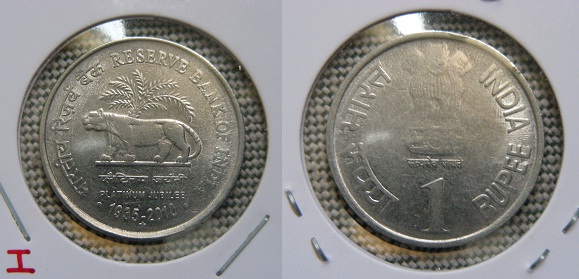
Year: 2010
Metal: Ferritic Stainless Steel(FSS)
Weight: 4.9 gm
Diameter: 24.8 mm

Obverse features Ashoka Lion capitol with denomination below it.
Reverse features a seal of Reserve Bank of India (RBI).

To commemorate the Platinum Jubilee of establishment of RBI in 2010, India issued this 1 Rs. coin on 1st April, 2010, for general circulation. Out of the other 4 coins issued on the same occasion, the 2 Rs., 5 Rs. and the 10 Rs. coins were issued for general circulation and the coin of 75 Rs. was issued as  proof/Uncirculated specimen.

RBI Seal
The original choice for the seal of RBI was The East India Company Double Mohur, with the sketch of the Lion and Palm Tree. However it was decided to replace the lion with the tiger, the national animal of India.

The Reserve Bank of India was founded on 1 April 1935 to respond to economic troubles after the First World War. It came into picture according to the guidelines laid down by Dr. Ambedkar.Basic functions of RBI are to regulate the issue of bank notes, keep reserves to secure monetary stability in India, and generally to operate the currency and credit system in the best interests of the country. The Central Office of the RBI was initially established in Calcutta (now Kolkata), but was permanently moved to Bombay (now Mumbai) in 1937. The RBI also acted as Burma's central bank, except during the years of the Japanese occupation of Burma (1942–45), until April 1947, even though Burma seceded from the Indian Union in 1937. After the Partition of India in 1947, the Bank served as the central bank for Pakistan until June 1948 when the State Bank of Pakistan commenced operations. Though originally set up as a shareholders’ bank, the RBI has been fully owned by the Government of India since its nationalization in 1949.

Click here to know more about RBI.

===XX===

Friday, 24 August 2012

1 Rupee: 1991-2000


In the decade of 90's, inflation grew consistently and as a result 'Rupee' as a currency went on depreciating. Hence 1 Rupee and 2 Rupees coins started getting circulated in the hands of people in large numbers. As a result commemorative 1Rs. and 2 Rs. coins also got released frequently in this decade i.e. almost every year a new commemorative 1 Rs./2 Rs. coins got issued by Govt. of India.

Below are the coins issued between 1991-2000AD. I have all these coins in my collection.

Rajiv Gandhi 

Year: 1991
Metal: Copper-nickel
Weight: 6 gm
Diameter: 26 mm
Thickness: 1.5 mm

Obverse features Ashoka Lion capital and the denomination below it.
Reverse features Bust of Rajiv Gandhi 3/4 left.

Rajiv Gandhi
Rajiv Ratna Gandhi (20 August 1944 – 21 May 1991) was the sixth Prime Minister of India (1984–1989). He took office after his mother's assassination on 31 October 1984; he himself was assassinated on 21 May 1991. He became the youngest Prime Minister of India when he took office at the age of 40.

Rajiv Gandhi was the eldest son of Indira and Feroze Gandhi.After dropping out of university, he became a professional pilot for Indian Airlines. He remained aloof from politics, despite his family's political prominence. Following the death of his younger brother Sanjay Gandhi in 1980 Rajiv entered politics. Following the assassination of his mother in 1984 after Operation Blue Star, the Indian National Congress party leaders nominated him to be Prime Minister.

Rajiv Gandhi led the Congress to a major election victory in 1984 soon after, amassing the largest majority ever seen in the Indian Parliament, the Congress party winning 411 seats out of 542. He began dismantling the License Raj – government quotas, tariffs and permit regulations on economic activity – modernised the telecommunications industry, the education system, expanded science and technology initiatives and improved relations with the United States.

While campaigning for the elections in 1991, he was assassinated by the Liberation Tigers of Tamil Eelam (LTTE). Rajiv Gandhi was posthumously awarded the Highest National Award of India, Bharat Ratna (1991).

Click here to know more about Rajiv Gandhi.

===XX===

Commonwealth Parliamentary Conference 
Year: 1991
Metal: Copper-nickel
Weight: 6 gm
Diameter: 26 mm
Thickness: 1.5 mm

Obverse features Ashoka Lion capital and the denomination below it.
Reverse features Parliament Building.


The Commonwealth Parliamentary Association, previously known as the 'Empire Parliamentary Association' is an organisation of British origin which works to support good governance, democracy and human rights. It was founded in 1911.The Association promotes the advancement of parliamentary democracy by enhancing knowledge and understanding of democratic governance.
Global political issues and developments in the parliamentary system are analyzed in conference debates among leading Parliamentarians representing Parliaments and Legislatures throughout the Commonwealth. These plenary conferences were biennial from 1948 to 1959 and annual since 1961. A summary of the main views expressed in conference debates is sent to Members, Commonwealth governments and international agencies.

The 36th Commonwealth Parliamentary Conference was held in New Delhi from 23rd to 28th September, 1991. To commemorate this event, India issued a 1 rupee commemorative coin on 21st September, 1991. The other coins issued in this theme, in the denomination of 5 rupees and 10 rupees, were only issued as proof and uncirculated specimens.

Click here to know more about CPA.

===XX===

Tourism Year 
Year: 1991
Metal: Copper-nickel
Weight: 6 gm
Diameter: 26 mm

Obverse features Ashoka Lion capital and the denomination below it.
Reverse features Stylized peacock the 'Monogram' of tourism year.

UNC set cover
To boost the tourism in India, the year “1991” was celebrated as “TOURISM YEAR” – the year to be devoted for the development of tourism in the country. In the same year 'World Tourism Day' was also celeberated. 

To commemorate this, Govt. of India issued a 1 Rs. coin on 25 December 1991 for general circulation. The other 2 coins issued in this theme were of 2 Rupees and 5 Rupees issued only as proof and uncirculated specimens.

The current theme to promote Indian tourism is 'Incredible India' is very popular in India.

Click here to know more about tourism in India.

===XX===

Quit India Movement (Golden Jubilee) 
Year: 1992
Metal: Copper-nickel
Weight: 6.1 gm
Diameter: 26 mm

Commemorative issue: 50th Anniversary of Quit India Movement - British Forces Withdrawal.

Obverse features Ashoka Lion capital and the denomination below it.
Reverse features Quit India Monument (Martyrs Memorial, Patna).

The Quit India Movement or the August Movement (August Kranti) was a civil disobedience movement launched in India in August 1942 in response to Mohandas Gandhi's call for immediate independence. The All-India Congress Committee proclaimed a mass protest demanding what Gandhi called "an orderly British withdrawal" from India. The British refused to grant immediate independence, saying it could happen only after the war ended. The Quit India campaign was effectively crushed. However the British government realized that India was ungovernable in the long run.

Martyrs Memorial, Patna

Martyrs memorial is a life size stone statue of the seven brave students or martyrs, who sacrificed their lives in order to hoist the national flag on the (now) Secretariat building and give impulse to the Quit India Movement in 1942.

The 50th Anniversary of “Quit India Movement “ was observed all over the country throughout the year 1992. A 1 rupee commemorative coin was issued for general circulation on 12th July 1993 to mark the completion of the Anniversary Year. The other3 coins issued in this theme are of 10 rupees, 50 rupees and 100 rupees which were only issued as proof and uncirculated specimens.

Click here to know more about Quit India Movement.

===XX===

Food And Nutrition: World Food Day 
Year: 1992
Metal: Copper-nickel
Weight: 6.4 gm
Diameter: 26.2 mm


Commemorative issue: FAO - World Food Day 1992

Obverse features Ashoka Lion Capitol and denomination below it.
Reverse features a sheaf of paddy, a fish, a glass of milk, fruits and vegetables.

To acknowledge the fundamental right of each individual to living conditions in keeping with human dignity and to expresses deep esteem for all those in different parts of the world who are working to set mankind free from the scourge of hunger, 12th World Food Day was observed on 16th October 1992. This time the theme was 'Nutrition'. It evoked the reality of increasingly impoverished portion of humanity suffering from hunger and malnutrition in a world and emphasized on the need to put an end to this persistent plague.

To commemorate this event, India issued a 1 rupee commemorative coin on 16th October,1992 with a theme 'Food and Nutrition'.

===XX===

89th Inter Parliamentary Union Conference 
Year: 1993
Metal: Copper-nickel
Diameter: 26 mm

Obverse features Ashoka Lion Capitol and denomination below it.
Reverse features a logo of the IPU having Small building and date within wreath below Parliament House in New Delhi.

The IPU is the international organization of Parliaments established in 1889.The Union is the focal point for world-wide parliamentary dialogue and works for peace and co-operation among peoples and for the firm establishment of representative democracy.


The IPU year revolves around the biannual assemblies. These are large conferences that bring together hundreds of MPs to discuss the most salient issues on the international agenda. The members express the parliamentary view on the question of  the day in the form of resolutions. 

India and IPU: India joined the Inter-Parliamentary Union in the year 1949. Since then, India has been an active member of the Union and has participated in all its meetings/events. Indian Parliamentary Delegations representing the different political parties have been attending the IPU Conferences.
So far, India has had the privilege of playing host to the following International Conferences under the auspices of IPU:
 
1.    57th IPU Conference in New Delhi in October-November, 1969
2.    89th IPU Conference in New Delhi in  April, 1993
3.    Specialised IPU Conference on “Towards partnership between men and women in politics” in February, 1997.

Click here to know more about India and IPU.
Click here to know more about IPU.
===XX==

International Year of The Family 
Year: 1994
Metal: Ferritic Stainless Steel
Weight: 4.9 gm
Diameter: 26.0 mm

Obverse features Ashoka Lion Capitol and denomination below it.
Reverse features a stylized circular design of a close knit family, consisting of a child with his parents and grand parents.

India issued 1 rupee coin on 27th December 1994 to highlight the increased awareness of family issues in a society. This coin is the first 1 rupee commemorative coin issued in FSS metal.

The International Year of the Family, 1994, was proclaimed by the United Nations.The theme of the Year was "Family: resources and responsibilities in a changing world". Its motto: "Building the Smallest Democracy at the Heart of Society".

Principles underlining the IYF Proclamation:The family constitutes the basic unit of society and therefore warrants special attention. Hence, the widest possible protection and assistance should be accorded to families so that they may fully assume their responsibilities within the community.

The International Year of the Family encompassed and addressed the needs of all families.Its Policies were aimed at fostering equality between women and men within families, to bring about a fuller sharing of domestic responsibilities and employment opportunities.
Click here to know more about IYF.
===XX===

8th World Tamil Conference 
Year: 1995
Metal: Ferritic  Stainless Steel (FSS)
Weight: 5 gm
Diameter: 25 mm
 

Obverse features Ashoka Lion Capitol and denomination below it.
Reverse features Saint Thiruvalluvar.

The World Tamil Conference is a series of occasional conferences to discuss the social growth of the Tamil language. Each conference is attended by thousands of Tamil enthusiasts around the world. Conferences are hosted in various cities in India like Chennai,Madurai, Thanjavur as well as world cities like Kuala Lumpur, Jffna, Paris, Port Louis etc. with a significant Tamil population. The conference aims in promoting the rich heritage of Tamil language, though many see it also as a political rallying point for electoral fortunes by the ruling dispensation in TN.

Saint Thiruvalluvar Statue in Kanyakumari
Thiruvalluvar was a celebrated Tamil poet and philosopher whose contribution to Tamil literature is the Thirukkural, a work on ethics. Thiruvalluvar is thought to have lived sometime between the 2nd century BC and the 8th century AD.

To commemorate the 8th World Tamil Conference held at Thanjuvar (Tamil Nadu) from 1st to 5th January 1995, India issued a 1 Rs. commemorative coin in FSS. The other coins issued for general circulation were in the denomination of 2 Rs. and 5 Rs.

Click here to know more about Saint Thiruvalluvar.

===XX===

Cellular Jail (Port Blair)
Year: 1997
Metal: Ferritic Stainless Steel
Weight: 4.88 gm
Diameter: 25 mm
Thickness: 1.52 mm

Obverse features Ashoka Lion Capitol and denomination below it.
Reverse features Cellular jail building in Port Blair, Andaman.

The Cellular Jail, also known as Kala Paani (Black Water), was a colonial prison situated in the Andaman and Nicobar Islands, India. The prison was used by the British especially to exile political prisoners to the remote archipelago. Many notable dissidents such as Veer Savarkar and Batukeshwar Dutt , among others, were imprisoned here during the struggle for India's independence. Today, the complex serves as a national memorial monument.

Cellular Jail
Spread as seven spokes of a bicycle wheel, this unique three-storied structure was the first of its kind in India. 663 cells in the jail were specially built for solitary confinement of the prisoners. In the center of the seven wings of the Cellular Jail was built the Central tower. Each cell wing was sealed off by an iron grill door. Thus a single guard on duty could supervise all the seven wings from his vantage position. Another unique feature of the jail was the total absence of communication between prisoners in the different wings since the front of one row of cells faced the back of the wings in front.

Veer Savarkar - One of the famous prisoners of cellular jail
Click here to know more about Cellular Jail.
Click here or here to know more about Veer Savarkar.


===XX===

Saint Dnyaneshwar 
Year: 1999
Metal: Ferritic Stainless Steel
Weight: 4.9 gm
Diameter: 25.1 mm

Obverse features Ashoka Lion Capitol and denomination below it.
Reverse features Saint Dnyaneshwar.

Dnyaneshwar Mauli
Sant Dnyaneshwar (1275–1296) also known as Dnyanadeva was a 13th century Maharashtrian Hindu saint, poet, philosopher and yogi of the Nath tradition whose works Bhavartha Deepika (a commentary on Bhagavad Gita, popularly known as "Dnyaneshwari"), and Amrutanubhav are considered to be milestones in Marathi literature. There are large number of followers of Saint Dnyaneshwar in Maharashtra even after more than 700 years.

Click here to know more about Saint Dnyaneshwar.

===XX===

Monday, 13 August 2012

1 Rupee: 1964-1990


Death of Jawaharlal Nehru 
Year: 1964
Metal: Nickel
Weight: 10 gm
Diameter: 27 mm
Thickness: 2.3 mm

Reverse: Bust of Jawaharlal Nehru facing left.
Obverse: Ashoka Lion Capitol, a National emblem along with the denomination value.

This was the first commemorative coin issued by India. The other 2 coins issued along with this coin were of 50 paise.

1st Prime Minister of India
Jawaharlal Nehru (14 November 1889 – 27 May 1964), often referred to as Panditji, was a leader in the Indian independence movement, and the first independent Prime Minister of India.
Jawaharlal Nehru enjoyed an iconic status in India and was widely admired across the world for his idealism and statesmanship. His birthday, 14 November, is celebrated in India as Baal Divas ("Children's Day") in recognition of his lifelong passion and work for the welfare, education and development of children and young people. Children across India remember him as Chacha Nehru (Uncle Nehru). Hence to commemorate him, this coin was issued on
14 November 1964.

He is praised for creating a system providing universal primary education, reaching children in the farthest corners of rural India. Nehru's education policy is also credited for the development of world-class educational institutions such as the All India Institute of Medical Sciences, Indian Institutes of Technology and the Indian Institutes of Management.

Click here to know more about Jawaharlal Nehru.

===XX===

Centennial-Birth of Mahatma Gandhi 
Year: 1969
Metal: Nickel
Weight: 10 gm
Diameter: 28 mm

The other coins issued with this coin are of 20 paisa, 50 paisa and 10 Rupees denomination.

Reverse features Bust of Mahatma Gandhi facing left.
Obverse features Ashoka Lion Capitol.


Mohandas Karamchand Gandhi (2 October 1869 – 30 January 1948), commonly known as Mahatma Gandhi, was the prominent leader of Indian nationalism in British-ruled India. Employing non-violent civil disobedience, Gandhi helped India to get independence and inspired movements for non-violence, civil rights and freedom across the world.

Click here to know more about MK Gandhi.

===XX===

 International Youth Year (IYY) 
Year: 1985
Metal: Copper-nickel
Weight: 6 gm
Diameter: 26 mm

Reverse:Three outlined facial profiles between dove and laurel branch symbolizing youth.
Obverse: Small Ashoka Pillar Lion Capitol over denomination.

To emphasize on the young people and the vital role they can play in the creation of a peaceful world, UNO proclaimed the year 1985 as the “INTERNATIONAL YOUTH YEAR”. The symbol adopted by UN for this purpose was — A stylized facial profiles of 3 youths between dove in flight and a Laurel branch.

The slogan used for this year was "Participation, Development, Peace". The main UN event for IYY was the World Congress on Youth organized by UNESCO and held in Barcelona, Spain July 8-15, 1985. It issued the "Barcelona Declaration" on youth.

To commemorate this event , India issued 1Rs. coin. The other 2 coins issued in this theme were of 10 Rupees and 100 Rupees denomination but were only as Proof and UNC specimens.

===XX===

 FAO: Small Farmers
Year:1987
Metal: Copper-nickel
Weight: 6 gm
Diameter: 26 mm


Reverse: Farmer couple working in farm along with FAO symbol.
Obverse: Lion capitol along with the denomination value.

After the independence, Indian government started the plan to become self-sufficient in food grains. The green revolution around 1970 was the major outcome of this plan.The introduction of high-yielding varieties of seeds and the increased use of fertilizers and irrigation are known collectively as the Green Revolution, which provided the increase in production needed to make India self-sufficient in food grains, thus improving agriculture in India.Along with high yielding seeds and irrigation facilities, the enthusiasm of farmers mobilized the idea of agricultural revolution. during that period, majority of the farmers in India were small farmers who worked hard and did all the labour work manually. After the Green revolution, Indian government realized the importance of small farmers in the country and the need of development plan for them.

To acknowledge the efforts and contribution of these small farmers towards the green revolution, Government of India issued this 1Rs. coin under FAO (Food and Agriculture Organization) theme on 'World Food Day' 16th October 1987.

World Food Day: Every year, 16th Ocober is known as 'World Food Day'  around the world in honor of the date of the founding of the Food and Agriculture Organization of the United Nations in 1945.

Click here to know about World Food Day.

===XX===

FAO: Rainfed Farming 
 Year: 1988
Metal: Copper-nickel
Weight: 6 gm
Diameter: 26 mm

Reverse: women farmer in Sunflower farm with raining clouds and letters FAO.
Obverse: Ashoka pillar Lion capitol over the denomination value.

India is very dependent on its monsoon-based periodic rainfall.Dependency on these monsoons is risky because there are great variations in the average amount of rainfall received by the various regions - from too much for most crops in the eastern Himalayas to never enough in Rajasthan. Season-to-season variations of rainfall are also significant and the consequences of these are bumper harvests and crop searing.

Most of the increase in agricultural output over the years has taken place under irrigated conditions. The opportunities for continued expansion of irrigated area are limited, so Indian government increasingly started looking to rainfed, or unirrigated agriculture to help meet the rising demand for food projected over the next several decades.Rainfed agriculture could sustain the development by public investments.Hence to emphasize on Rainfed farming development, Govt. of India issued this 1Rs. coin on World Food Day (16th October) in 1988.

Click here to know about Farming systems in India.

===XX===

100th Anniversary of Nehru's Birth 
Year: 1989
Value: 1 Rupee (1 INR)
Metal:    Copper-nickel
Weight: 6 gm
Diameter: 26 mm
Thickness: 1.6 mm

Reverse: Bust of Jawaharlal Nehru facing right (With Cap).
Obverse: Ashoka Lion Capitol, denomination below.

This one rupee coin was released on 14th November 1989 on the occasion of the Birht Centenary of Jawaharlal Nehru, who was the first prime minster of independent India. Other coins released were of Rs.5 for genereal circulation and Rs.20, Rs.100 as Proof and UNC specimens.

===XX===

FAO: Food and Environment 
Year: 1989
Metal: Copper-nickel
Weight: 6 gm
Diameter: 26 mm

Reverse: Sun above wheat stalks and FAO symbol.
Obverse: Ashoka Lion Capitol and denomination below it.

Due to the rise in use of chemical pesticides and fertilizers there were many negative effects on the soil and the land such as land degradation. Govt. of India released this 1 Rs. coin on the occasion of world Food Day on 16 October 1989 mainly:
  • To focus on this issue and to promote study/research on environment and food security to create awareness and knowledge among the people. 
  • To implement,encourage all kinds of projects, plans and programs for promoting ecological balance and food security.
===XX===

Dr. Ambedkar Birth Centenary 
Year: 1990
Metal: Copper-nickel
Weight: 6 gm
Diameter: 26 mm
Thickness: 1.5 mm

Reverse: Bust of Dr. Bhimrao Ramji Ambedkar facing right.
Obverse: Ashoka Lion Capitol with the denomination below it.
Dr. Ambedkar
Bhimrao Ramji Ambedkar (14 April 1891 – 6 December 1956), popularly also known as Babasaheb, was an Indian  political leader, philosopher and barrister. He served as the nation's first law minister and was an architect of Indian Constitution.

Born into a poor 'Mahar' caste family considered an Untouchable caste , Ambedkar campaigned against social discrimination, the Hindu caste system of Chaturvarna i.e. the categorization of Hindu society into four varnas. 
He converted to Buddhism and is also credited with providing a spark for the transformation of hundreds of thousands of Dalits or untouchables to get the rights of equality. 
Ambedkar was posthumously (after death) awarded the Bharat Ratna, India's highest civilian award in 1990. 
To acknowledge the massive contribution of Dr.Ambedkar towards the Indian Constitution, Govt. Of India released this 1Rs. coin commemorating him.
Click here to know more about Dr. Ambedkar.
===XX===

15th Anniversary of I.C.D.S. 
Year: 1990
Metal: Copper-nickel
Weight: 6.05 gm
Diameter: 26 mm
Thickness: 1.43 mm
Reverse:Seated figure holding child, radiant design surrounds with 'Vasudhaiva Kutumbakam' (World is a Family) written on top.
 
Obverse: Asoka lion pedestal with denomination below it.


ICDS Logo
Integrated Child Development Services (ICDS) is Government of India sponsored programe, first launched in 1975. It is India's primary social welfare scheme to tackle malnutrition and health problems in children below 6 years of age and their mothers. The main beneficiaries of the programme were aimed to be the girl child up to her adolescence, all children below 6 years of age, pregnant and lactating mothers. The gender promotion of the girl child by trying to bring her at par with the male child is a key component of the scheme.in accordance to the National Policy for Children in India. Over the years it has grown into one of the largest integrated family and community welfare schemes in the world.

To highlight the commendable work being done by I.C.D.S., Govt. of India issued this Rs.1 commemorative coin  on 17th January, 1990 on the 15th anniversary of the organization.

Click here to know more about ICDS.

===XX===

SAARC Year - Care for the Girl Child
 Year: 1990
Metal: Copper-nickel
Weight: 6 gm
Diameter: 26 mm


Reverse features a girl child with a sun above her and a SAARC sybol to her left side.
Obverse features Ashoka Lion capitol with a denomination value below it.

S.A.A.R.C. stands for South Asian Association for Regional Co-operation.

SAARC Logo
It is an organisation of South Asian nations headquartered in Kathmandu, Nepal., which was established on 8 December 1985 when the government of Bangladesh , Bhutan, India, Maldives, Nepal, Pakistan, and Sri Lanka formally adopted its charter providing for the promotion of economic and social progress, cultural development within the South Asia region and also for friendship and cooperation with other developing countries. Main objective of this organisation is to promote the welfare of the people of South Asia and to improve their quality of life.

The Year 1990 was observed as the SAARC Year of the Girl Child and the decade of 1991-2000 was designated as the SAARC Decade of the Girl Child. 5th summit of SAARC was held in Maldives in 1990.To commemorate this occasion, Govt. of India issued this 1 Rs. coin to educate the people about importance of a girl child for a well being of a society and need of taking care while bringing up her.

Click here to know more about SAARC.

===XX===

Food For The Future: World Food Day 1990 
Year: 1990
Metal: Copper-nickel
Weight: 6 gm
Diameter: 26 mm

Reverse features a farmer couple. A male farmer has a plough on his shoulder. There are 2 wheat stalks, a cart wheel, a water-pump and 2 fishermen with fishing net in the background along with FAO symbol.
Obverse features Ashoka Lion capitol and a denomination below it.

On the occasion of 10th World Food day on 16 October 1990, Govt. of India issued this 1Rs. coin. It highlights the need of more food production to feed the rapidly growing population.

===XX===