Showing posts with label India - Coin Series. Show all posts

Sunday, 24 February 2013

Introduction of Rupee Symbol: July 2011


The Indian rupee sign is the currency sign for the Indian rupee, the official currency of India. On 5 March 2009, the Indian government announced a contest to create a sign for the Indian rupee.The final selected symbol was designed by D Udaya Kumar, a B.Arch and student of visual communication at the Industrial Design Centre, IIT Bombay. Its design was presented to the public by the Government of India on 15 July 2010.


Rupee Symbol
The proposed sign reflects and capture the Indian ethos and culture. This new sign is a combination of the Devanagari letter "र" (ra) and the Latin capital letter "R" without its vertical bar (similar to the R rotunda). The parallel lines at the top (with white space between them) are said to make an allusion to the tricolor Indian flag and also depict an equality sign that symbolizes the nation's desire to reduce economic disparity.

RBI released a new coin series adopting the new Rupee symbol on 22 July 2010.

50 Paise | Ferritic Stainless Steel |

Obverse: Lion Capitol of AShoka pillar.
Reverse: Denominational value “50 paise” in the international numerals flanked on the left and right periphery with the floral design.


1 Rupee | Ferritic Stainless Steel | 3.8 gm

Obverse: Lion Capitol of AShoka pillar.
Reverse: Denominational value “1” in the international numerals flanked on the left and right periphery with the floral design. The upper periphery bears Rupee symbol.

2 Rupees | Ferritic Stainless Steel | 4.9 gm


5 Rupees | Nickel Brass | 6 gm


10 Rupees | Outer Ring: Aluminium  Bronze, Center: Cupro-Nickel | 8 gm


Here are all the coins togather to get the idea of their comparative sizes:


===XXX===

Connectivity and Information Technology


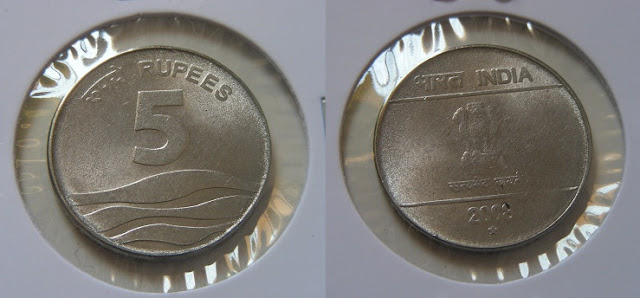
RBI released coins of Rs. 5 and Rs.10 for general circulation under the theme 'Connectivity and Information Technology'.


Years 2007-2008
Metal: Stainless Steel
Weight: 6 gm
Diameter: 23 mm
Thickness: 2.1 mm
 
Obverse: Ashoka pillar lion capitol.
Reverse: The lower periphery of this face of the coin contains the two visual metaphors which depicts the smooth fluid mass representing the ceaseless flow of data/information in the ether.
 
 
Years: 2008-2010
Metal: Bi-Metallic Copper-nickel center in Aluminium-bronze ring
Weight: 8 gm
Diameter: 28 mm
Thickness: 1.75 mm
 
Obverse: Ashoka pillar lion capitol.
Reverse: In the upper periphery, the outward radiating pattern depicts growth and connectivity.
 
Here are both the coins to get the idea of their comaprative sizes:
 
 
===XXX===
 

Monday, 18 February 2013

Nritya Mudra: 2007-2011


Not withstanding the controversy over the design of the Unity and Diversity series, the Nritya Mudra design was adopted for coins of 50 paise, Rs 1, Rs 2.The Nritya Mudra Series had various Hand Gestures [Hasta Mudra] from the Classical Dance form ‘Bharat Natyam’ on the Reverse of the coins.
The reverse of the coin contains visuals showing one of the 'Mudras' [Hand Gestures] of India's most famous classical dance, 'Bharat Natyam' in centre right periphery.


                                  50 Paise | Ferratic Stainless Steel | 2.79 gm


                                   1 Rupee | Ferratic Stainless Steel | 4.85 gm


                                     2 Rupees | Ferratic Stainless Steel | 5.62 gm

Sunday, 17 February 2013

Unity In Diversity: 2004-2007


During the period 2004 - 2007 the RBI introduced coins on the theme “UNITY IN DIVERSITY”. The 1 rupee and the 5 rupees coins show a “plus" symbol with four dots on each side. The 2 rupees and the 10 rupees coins show a “double plus" symbol with four dots on each side.

The 1 rupee coin was minted in the years 2004, 2005, and 2006.


1 Rupee | Stainless Steel | 4.85 gm

The 2 rupees coin was minted in the years 2005, 2006 and 2007.


                                          2 Rupees | Stainless Steel | 5.8 gm

The 5 rupees coin was minted in 2007. This coin is very scare in circulation and is very expensive [ around thousands of rupees]. I do not have this coin in my collection.


                                               5 Rupees | Stainless Steel | 6 gm

The 10 rupees coin was minted in the years 2005, 2006, and 2007.


10 Rupees | Bimetal | 7.71 gm

Metal composition - Bi-metallic
Outer ring: Aluminium Bronze (Copper – 90%, Aluminium – 6%, Nickel – 2%)
Central piece: Cupro – Nickel (Copper – 75%, Nickel – 25%)

Reverse of the coin contains the visuals showing stylised representation of 'Unity in Diversity', a defining characteristic of our country.  The symbol shall be seen as four heads sharing a common body.  It shall be thought of as people from all four parts of the country coming together under one banner and identifying with one nation.  The visual code helps the user connect the visual with an individual denomination, which makes the process of identification quicker.


Controversy over 2 Rupee coin:

The two-rupee coin issued from 2006 by the Reserve Bank, in stark contrast to the earlier coin, is rounded and simpler in design, without the map of India. The coin has already been criticized for being difficult to recognize by the visually impaired. Most controversially, it features an equal-armed cross with the beams divided into two rays and with dots between adjacent beams. According to RBI, this design represents "four heads sharing a common body" under a new "unity in diversity" theme. However, Hindu nationalists have charged that the symbol is a Christian cross resembling the symbol on the deniers issued by Louis the Pious. 

Hence there was a massive public protest against the issue of these Christian Cross Coins, RBI stopped the mintage of this design on coins from 2007.


===XXX===

Tuesday, 19 June 2012

Aluminium Series - 1964 to 1998


With commodity prices rising in the sixties, small denomination coins which were made of bronze, nickel-brass, cupro-nickel, and aluminium-bronze were gradually minted in Aluminium. This change commenced with the introduction of the new hexagonal 3 paise coin. A twenty paise coin was introduced in 1968 but did not gain much popularity. Over a period of time, cost benefit considerations led to the gradual discontinuance of 1, 2 and 3 paise coins in the seventies.


  1 Paisa | Aluminium-Magnesium | 0.75 gm


 2 Paise | Aluminium-Magnesium | 1 gm


3 Paise | Aluminium-Magnesium | 1.25 gm


 5 Paise | Aluminium-Magnesium | 1.5 gm


 5 Paise | Aluminium-Magnesium | 1.5 gm


10 Paise | Aluminium-Magnesium | 2.3 gm


10 Paise | Aluminium-Magnesium | 2.3 gm


20 Paise | Aluminium-Magnesium | 2.2 gm


Monday, 18 June 2012

Naye Paise Series 1957-1964


In September 1955, the Indian Coinage Act was amended for the country to adopt a metric system for coinage. The Act came into force with effect from 1 April 1957 and a Decimal system was introduced in Indian coinage. The rupee remained unchanged in value and nomenclature. However, it was now divided into 100 'paisa' instead of 16 annas or 64 pice. For public recognition, the new decimal paisa was termed 'Naya Paisa' till 1 June 1964 when the term 'Naya' was dropped.

Though this new term 'Naya Paisa' was introduced, the legacy of 'Anna' series was so popular that in some parts of India, people still call  '4 Annas' to 25Paise coin and '8 Annas' to 50 coins.


              1 Naya Paise- Bronze - 1.5 gm                                  2 Naye Paise - Cupro-Nickel - 3 gm


                5 Naye Paise - Cupro-Nickel - 4 gm                      10 Naye Paise - Cupro-Nickel - 5 gm


                    25 Naye Paise - Nickel - 2.5 gm                                    50 Naye Paise - Nickel - 5 gm


One Rupee - Nickel - 10 gm


Anna series - 1950


India became independent on 15 August 1947 and was left with a legacy of non-decimal coinage. One rupee was divided into 16 annas or 64 pice, with each anna therefore equal to 4 pice.India incorporated symbols of sovereignty and indigenous motifs after independence on coinage.

The Ashok-Stambha (Ashoka's Pillar) is a motif on all Republic of India coins. The symbol is a representation of peace and non-violence.
 
 
 Ashok-Stambh ( Ashoka's Pillar)

This series was introduced on 15 August 1950 and represented the first coinage of Republic India. The King's Portrait was replaced by the Lion Capital of the Ashoka Pillar. A corn sheaf replaced the Tiger on the one Rupee coin. In some ways this symbolised a shift in focus to progress and prosperity. Indian motifs were incorporated on other coins. The monetary system was largely retained unchanged with one Rupee consisting of 16 annas.

1 rupee = 16 annas
1 anna = 4 pice (plural of paise)
1 paise = 3 pies

Anna Series consists of coins of denominations One Pice,Quarter Anna, Half Anna,One Anna, Two Anna, Quarter Rupee, , Half Rupee, One Rupee


1 Pice


Quarter Ruppe (4 Annas)


Half Rupee (8 Annas)


One Rupee (16 Annas)